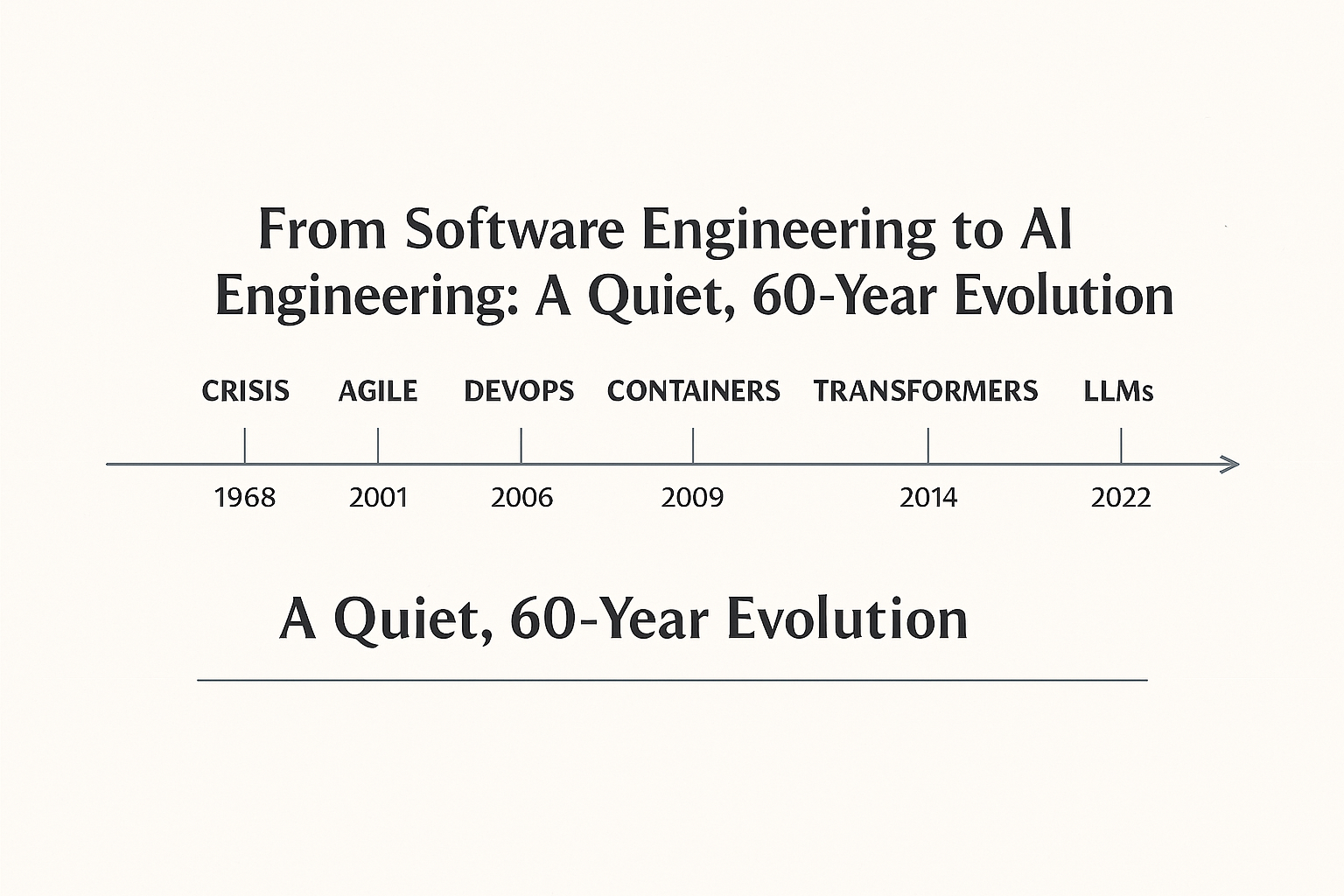
From Software Engineering to AI Engineering: A Quiet 60‑Year Evolution
If you’ve been in software long enough, you’ve probably felt this moment before.
A new term appears everywhere.
Job titles start shifting.
New tools explode overnight.
LinkedIn timelines declare a before and after.
Today, that term is AI Engineer 🤖.
It feels dramatic — almost like everything we’ve done so far is suddenly outdated.
But if you pause and look at the long arc of our field, something familiar begins to surface:
This is not the first time software engineering has “changed forever.”
And every time it happened, the discipline didn’t disappear — it adapted.
To understand what actually changed (and what didn’t), we need to rewind.
💥 When Software Became Too Big for Its Own Good (1960s)
In the early days, software was small.
Programs were written by a handful of people, often by the same teams building the hardware.
Then systems grew.
Projects started missing deadlines.
Budgets spiraled.
Codebases became impossible to fully understand.
In 1968, a group of experts gathered at a NATO conference and deliberately used a provocative term:
“software engineering.”
Not because software was sophisticated — but because it was failing.
The fear was simple and deeply human:
If we don’t treat software like an engineering discipline, complexity will defeat us.
From day one, the problem was never “how do we write code?”
It was how do we build systems that can survive change.
That question never left us.
🏢 The Enterprise Years: Stability Above All Else (1980s–1990s)
As software moved into banks, airlines, telecom, and governments, the rules changed.
Failure wasn’t embarrassing anymore.
Failure was dangerous.
So the industry responded with:
- heavyweight processes
- long requirement phases
- extensive documentation
- infrequent releases
Looking back, this era feels slow. But it taught a foundational truth:
Software engineering lives inside real‑world constraints —
financial, legal, organizational, and human.
Engineering matured here — even if innovation slowed.
🏃 Agile: When We Rediscovered Feedback (2001)
By the late 1990s, something felt off.
Teams were “successful” on paper
…and still shipping the wrong thing — late.
In 2001, a small group met at Snowbird and wrote the Agile Manifesto.
It wasn’t rebellion.
It was course correction 🎯.
Agile didn’t say “planning is useless.”
It said learning earlier matters more than pretending we know everything upfront.
Short cycles.
Frequent demos.
Real feedback.
Engineering didn’t disappear — it moved closer to reality.
☁️ When the Economics Changed Overnight (2006)
Then something extremely subtle — and extremely powerful — happened.
In 2006, Amazon launched S3 and EC2.
Suddenly:
- you didn’t buy servers
- you didn’t wait weeks for infrastructure
- you paid only for what you used
This wasn’t just a tech shift.
It was an economic shift 💰.
Architecture decisions now had monthly costs attached to them.
Engineering quietly absorbed finance.
🔄 DevOps: Making Shipping Boring (2009)
In 2009, a talk casually mentioned deploying 10+ times a day.
At the time, that sounded reckless.
Deployments were events.
They required coordination, weekends, and courage.
DevOps flipped the story.
Instead of:
Deployments are scary
the mindset became:
Deployments are safe because they’re routine
Automation, monitoring, shared responsibility —
not to go faster, but to reduce risk through frequency ✅.
📦 Containers & Microservices: Reality Became Distributed (2013–2014)
Docker made environments reproducible.
Kubernetes made large systems manageable.
Microservices gave teams autonomy — and exposed new pain.
This is when many of us truly felt distributed systems:
- latency
- partial failures
- cascading outages
And the lesson repeated itself:
Every new capability solves one problem and creates another.
Engineering didn’t get easier.
It got more honest.
🧠 A Quiet Research Paper That Changed Everything (2017)
In 2017, a paper introduced the Transformer architecture.
At first, it felt academic.
But it removed a deep limitation:
machines could now process language in parallel and generalize across tasks.
What changed wasn’t intelligence —
it was that language became a usable software interface.
That detail mattered more than anyone realized at the time.
🌍 The Moment Everyone Felt It (2022)
In November 2022, ChatGPT was released publicly.
For the first time, non‑technical users experienced:
- useful conversations
- real productivity
- immediate value
AI crossed a boundary:
From “research capability” to “product expectation.”
And engineers responded the only way we know how:
Alright. How do we ship this responsibly?
🔀 What Actually Changed
Deterministic Logic → Probabilistic Capability
Traditional software behaves like a math problem: same input → same output.
LLM‑based systems don’t.
They introduce probabilistic behavior inside deterministic systems 🎲.
That single shift creates new responsibilities:
- evaluation instead of pass/fail tests
- guardrails instead of hard rules
- runtime cost control (tokens)
- designing systems that expect uncertainty
This — not prompts, tools, or titles — is the real shift.
🧱 What Didn’t Change (And Never Will)
We still:
- design architectures
- define boundaries
- manage failures
- optimize cost and latency
- own production outcomes
AI engineering doesn’t replace software engineering.
It extends the discipline — the same way cloud and DevOps did before.
🔜 Up Next: Part 2
“What an AI‑Ready Software Engineer Actually Does Differently”
Concrete habits.
System patterns.
Decision‑making shifts.
No hype.
Just engineering.
``