How Structured, OOP, and Functional Thinking Shape Real‑World Rails Apps
A deep, simple, and practical perspective inspired by Clean Architecture
While reading Clean Architecture by Robert C. Martin, one idea quietly keeps resurfacing—not as a rule, but as a way of thinking.
Good software is not built by choosing a single programming style.
It is built by balancing multiple ways of thinking about code.
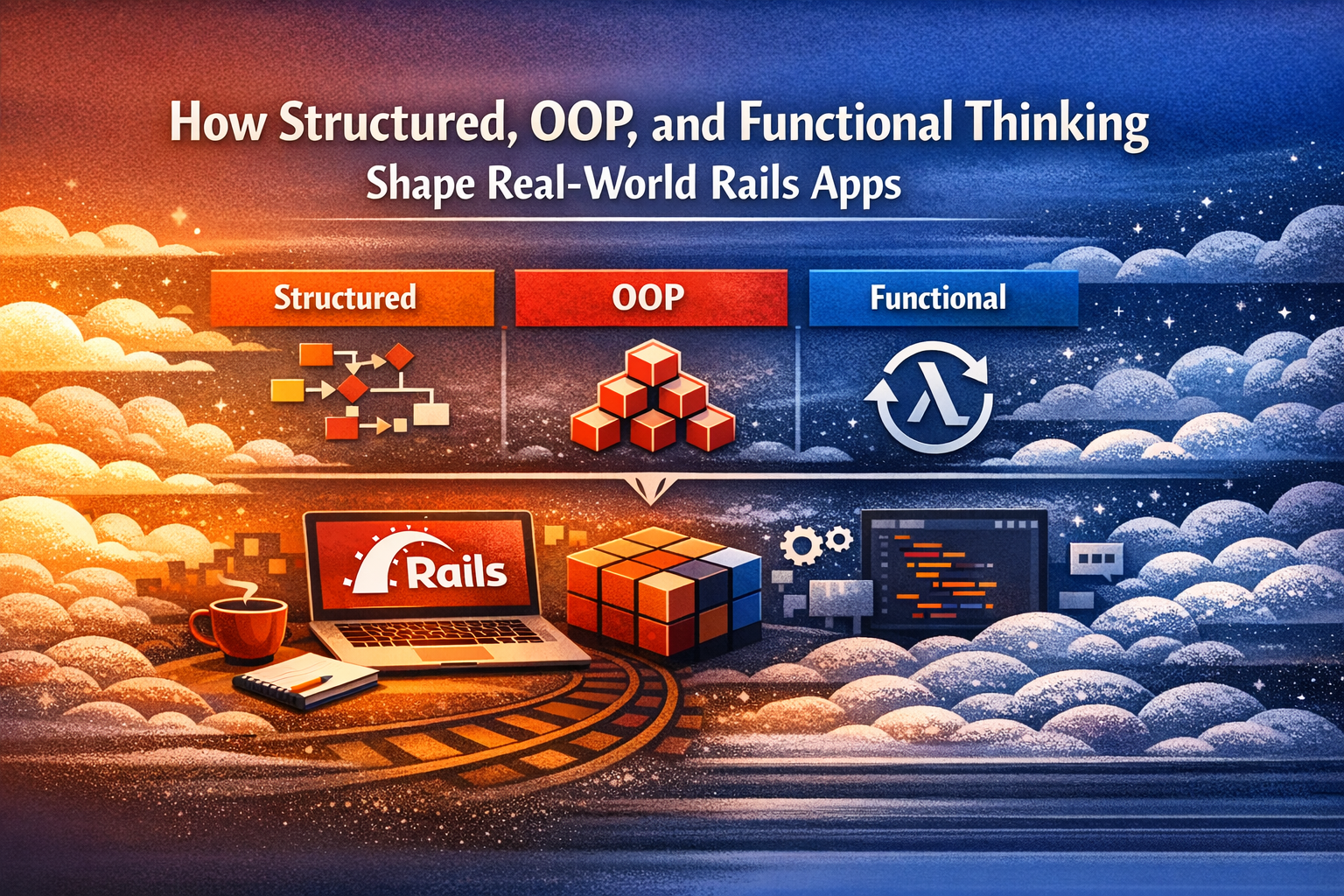
Three paradigms appear again and again beneath the surface:
- 🧱 Structured Programming
- 🧩 Object‑Oriented Programming (OOP)
- 🧪 Functional Programming (FP)
At first glance, these sound like academic concepts. But once you start observing real Rails applications closely, something becomes clear:
💡 You are already using all three paradigms every single day.
The difference between average and well‑designed systems is not whether these paradigms are used, but where and how consciously they are applied.
This article is not a theoretical breakdown.
It is a practical mental model to understand how these paradigms naturally fit together inside real‑world Rails applications.
🧭 Programming paradigms as ways of thinking
A programming paradigm is not about syntax.
It’s not about choosing Ruby over JavaScript or Rails over Django.
A paradigm is simply a:
way of thinking about how code should be organized.
Think of it like:
- different ways to run a kitchen,
- different ways to manage a team,
- different ways to solve the same problem.
The goal is the same—but the approach changes depending on what you’re trying to control: flow, responsibility, or data.
Each paradigm shines when applied to the right kind of problem.
🪙 A simple problem, three different perspectives
To keep things concrete, let’s reuse a tiny example:
✂️ Calculate the final price after applying a discount.
Intentionally trivial—so the thinking style becomes obvious.
🔁 Structured programming: thinking in flow
Structured programming is the oldest and most intuitive style.
Its mental model is simple:
➡️ Do this, then do that.
It focuses on:
- sequence
- conditions
- step‑by‑step execution
price = 100
discount = 10

if discount > 0
  final_price = price - discount
else
  final_price = price
end

puts final_price
It reads like a recipe.
This style maps naturally to processes and workflows.
class CheckoutOrder
  def call(order)
    validate_inventory(order)
    reserve_stock(order)
    charge_payment(order)
    send_confirmation(order)
  end
end
This isn’t “what an Order is.”
It is directing traffic, which is exactly what structured programming is good at—controlling execution flow.
🧱 Object‑oriented programming: thinking in responsibility
OOP shifts the question.
Instead of:
“What steps should I write?”
You ask:
“Who should be responsible for this behavior?”
OOP bundles data + behavior together.
class Order
  def initialize(price)
    @price = price
  end

  def final_price(discount)
    @price - discount
  end
end
Rails is deeply object‑oriented:
- User
- Order
- Invoice
- Subscription
These aren’t just rows—they’re domain concepts.
class Order < ApplicationRecord
  def paid?
    status == "paid"
  end

  def total_amount
    line_items.sum(&:price)
  end
end
This logic belongs to the model because:
- it depends on order data
- it defines what an order means
This is OOP doing what it does best: controlling responsibility and boundaries.
🧪 Functional programming: thinking in transformation
FP takes a different view:
Input → Output
- No hidden state
- No side effects
- Same input → same output
def final_price(price, discount)
  price - discount
end
You use this style daily in Rails:
orders
  .select(&:paid?)
  .map(&:total_amount)
  .sum
This is pure data transformation.
Functional thinking is perfect for:
- reporting
- analytics
- transformations
- aggregations
Predictability is its superpower.
🔍 Seeing the three styles side by side
Each paradigm answers a different question:
- Structured → What happens next?
- OOP → Who owns this behavior?
- Functional → How does data change?
Trying to force one style everywhere leads to messy designs.
The skill is in choosing the right question at the right time.
🏗️ How this fits naturally inside Rails
In mature Rails apps, the separation becomes clear:
- 🧱 Object‑oriented code → domain modeling
- 🔁 Structured code → use cases & workflows
- 🧪 Functional code → calculations & transformations
This balance is exactly what Clean Architecture encourages.
🧲 Where Clean Architecture quietly guides you
Clean Architecture doesn’t force a paradigm—it guides when to use each:
- Use Structured to control flow
- Use OOP to control dependencies & boundaries
- Use FP to control state & predictability
Balanced well, systems become:
- easier to test
- easier to change
- easier to reason about
⚠️ A common Rails pitfall
A frequent mistake is collapsing all three paradigms into models:
class Order
  def process!
    validate_inventory
    charge_payment
    send_email
    sync_to_erp
  end
end
Now the model is:
- a domain object
- a workflow engine
- an integration layer
This works for a while… until it doesn’t.
A healthier separation:
- models → behavior
- services → flow
- pure functions → data transformation
💡 A useful way to think before writing code
Ask yourself:
- Is this business meaning? → OOP
- Is this coordinating steps? → Structured
- Is this transforming data? → Functional
This tiny mental check saves major refactors later.
🎯 A closing perspective
Great systems don’t choose a single paradigm.
They blend them intentionally.
That’s what:
- Clean Architecture promotes
- Mature Rails apps evolve toward
- Scalable systems depend on
Don’t think in terms of syntax.
Think in terms of responsibility, flow, and transformation.
Once this mental model clicks, architecture becomes surprisingly obvious.