The Invisible Decision That Decides Whether Your Software Lives or Dies
🏗️ Clean Architecture — The Invisible Decision That Decides Whether Your Software Lives or Dies
Exploring the real purpose of software design, the hidden cost of ignoring structure, and why protecting architecture determines long‑term productivity - the first two chapters of Clean Architecture by Robert C. Martin
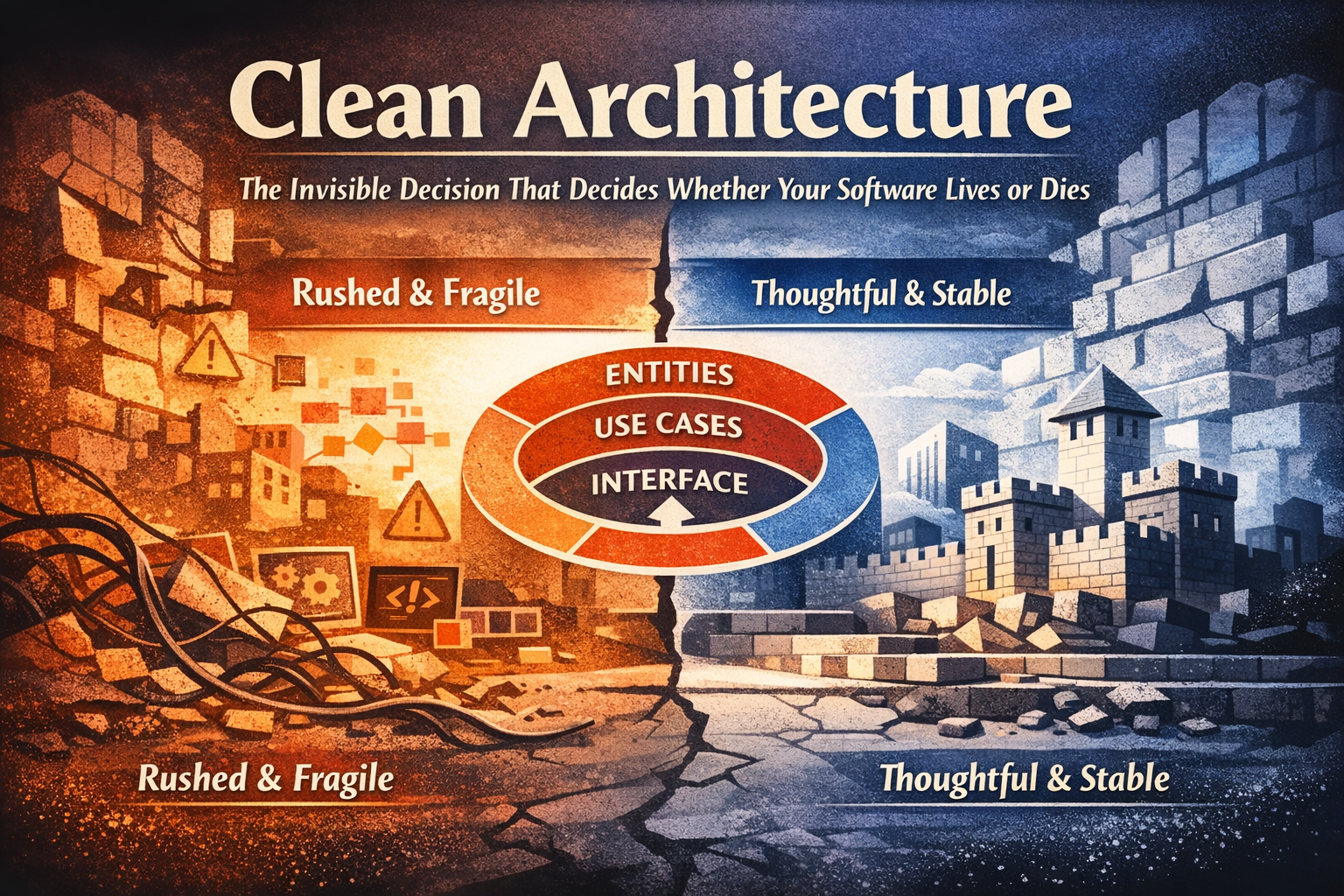
Let’s begin with a story.
Imagine two teams building two different products.
Both launch successfully. 🚀
Both impress users. 😊
Both move fast in the beginning.
Two years later…
- One team ships confidently. 💪
- The other fears touching their own code. 😰
What changed?
Not the developers.
Not the tools.
Not even the business model.
The real difference was something invisible:
Architecture.
This is what the first two chapters of Clean Architecture are really about.
Not diagrams. Not layers. Not patterns.
They’re about survival.
📖 Chapter 1 — The Lie We Tell Ourselves
Most teams begin with one shared belief:
“The goal of software is to make it work.”
And early on, that seems true:
- Features ship fast
- Users are happy
- The product grows 📈
- Everything feels productive
Then quietly, something shifts…
- A “small change” takes too long
- A tiny tweak breaks unrelated parts
- Releases become stressful 😓
- New developers struggle to onboard
The system didn’t break —
it hardened.
And then comes the uncomfortable truth:
🎯 The goal of software is not just to work.
The goal is to stay easy to change.
Software is not a sculpture.
It’s a living organism. 🌱
It must adapt to survive.
⚠️ The Productivity Illusion
Early speed is a trap.
At the beginning:
- Development feels fast ⚡
- Features feel easy
- Progress feels visible
So teams assume:
“We’re doing great.”
But bad architecture doesn’t punish you immediately.
It waits. ⏳
Until one day:
- Every change touches five files
- Every release feels risky
- Every refactor becomes “later”
That’s not a developer problem.
That’s design debt crystallizing.
Architecture isn’t about building something impressive.
It’s about preventing slow decay. 🧱
📖 Chapter 2 — The Two Values No One Talks About
Chapter 2 introduces a crucial idea:
Software has two values.
Most teams see only one.
💡 Value #1 — Behavior (Visible)
This is what stakeholders notice:
- Features
- Reports
- Buttons
- Business rules
It’s visible 👀
It’s measurable
It’s urgent
But it’s not the whole picture.
🏛️ Value #2 — Architecture (Invisible)
Architecture is the structure under the features.
It determines:
- How hard it is to change something
- How long features take to ship
- Whether new developers onboard smoothly
- Whether a feature feels safe or scary to modify
Architecture does not show up in demos.
It shows up in every future decision. 🔮
⚖️ The Daily Conflict
The business says:
“We need this by Friday.”
The system whispers:
“If you push me too hard, I’ll become fragile.”
Guess who wins?
Urgency.
Every time.
Shortcut → shortcut → shortcut.
“We’ll clean it later.” 🧹
But “later” rarely arrives.
And productivity collapses —
not because developers got worse,
but because the structure stopped supporting change.
🏆 So Which Value Is Greater?
A bold insight from the author:
Behavior delivers value today.
Architecture delivers value tomorrow.
And tomorrow always comes.
If a feature is wrong, you can rewrite it.
If the architecture is wrong,
every rewrite becomes painful.
That makes architecture the greater value—
not because it’s glamorous,
but because it protects everything else. 🛡️
🏠 A Simple Metaphor
Think of a house:
- Behavior is the furniture 🪑
- Architecture is the foundation 🧱
You can rearrange furniture anytime.
But if the foundation cracks,
every change becomes dangerous.
Most teams obsess over furniture.
Few protect the foundation.
🥊 The Hardest Part: Fighting for Architecture
No one will create a ticket titled:
“Please protect the architecture.”
It won’t feel urgent.
Stakeholders won’t request it.
It won’t impress in demos.
But it is your responsibility.
Because if no one defends structure:
- Complexity grows 📉
- Fear grows 😟
- Speed dies 🐢
Architecture isn’t about perfection.
It’s about preserving options —
for future developers, and future you.
🧠 What These Two Chapters Are Really Saying
They’re not teaching patterns yet.
They’re teaching perspective.
Chapter 1:
Build systems that remain changeable.
Chapter 2:
Protect the structure that keeps them changeable.
Together they reveal a quiet truth:
Software success isn’t measured by how fast you ship today —
but by whether you can still ship confidently three years from now.
🌟 Final Reflection
Fast delivery feels impressive.
Sustainable delivery is powerful.
Good developers write working code.
Responsible developers protect the future.
And that — more than any pattern or diagram —
is what Clean Architecture begins with.